Symphony Dream
KEVIN, nine-years old. While rehearsing for a school play, he decides to become music. Obstinate in this objective, he gradually realizes that what seems to be impossible can become real. He says to his father: “Imagine this: you wake up, put your son in the shower, make him breakfast, he eats it and thanks you. Then you make him a snack, put perfume on him, some on his head to prevent lice. Then you start the car, put on your seatbelt, and drive him to school. When you get there you give him a kiss and wish him a wonderful day. You ask him to behave, eat all of his snack, stay out of trouble, and to not eat too much candy. And when he comes back home, instead of bringing back a backpack full of homework for the next day, he brings a stomach with a bullet through it.”
The play begins on the 7th birthday of Kevin’s little sister Célia, as her family moves to the town where their mom will be a school principal. Soon after arriving, Célia and Kevin survive a school shooting.
Symphony Dream is Brazilian playwright Diogo Liberano’s response to the 2011 massacre at Rio de Janeiro’s elementary school Tasso da Silveira in light of Deleuze and Guattari’s The Anti-Oedipus: Capitalism and Schizophrenia, and Lionel Shriver’s We Need to Talk About Kevin. Symphony Dream is a non-realist play that utilizes highly poetic imagery to take a political stance about school shootings and violence against children
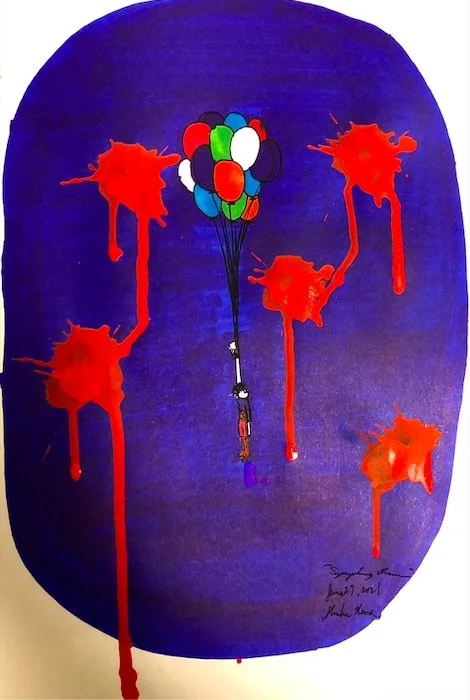
Art by Shosuke Noma
Symphony Dream was translated by Elizabeth Jackson for Theater—Yale’s Journal of Criticism, Plays, and Reportage. Tatinge Nascimento and Thomas Sellar, co-editors. 45: 2 (2015). 29-63.
Symphony Dream is the recipient of the MN Arts Board Arts Experiences and Metropolitan Regional Council Flexible Support 2026-27 grants.